
Why Single-Phase Power Conversion Is Changing in Off-Grid Farming
Remote farms often begin with simple electrical systems. Lighting, small pumps, workshop tools, and residential loads can usually operate from a single-phase supply. As the farm expands, its power demand can change. Larger irrigation pumps, refrigeration equipment, grain handling machines, and processing motors may place different demands on the system.
This is why some farms are reviewing whether a single phase to 3 phase inverter arrangement is necessary. The decision is not simply about installing a larger inverter. It depends on the equipment being added, the way loads start and run, and whether future expansion will require three-phase power.
Why Farm Power Demand Changes
Farm electrical demand often grows in stages. Irrigation may be the first major load, followed by ventilation, cold storage, feed processing, or workshop equipment. These additions do not only increase total power consumption. They can also create higher startup current and uneven operating periods.
Motor-driven equipment deserves attention. Some pumps, compressors, and processing machines are designed for three-phase power. If these loads are added to a farm originally built around single-phase output, the existing electrical structure may no longer match the operating requirements.
An off grid solar inverter should therefore be selected as part of the power system. Engineers need to review motor starting characteristics, battery discharge capacity, PV input, cable sizing, and expected simultaneous loads. Looking only at rated inverter power can hide problems that appear during operation.
For farms with small single-phase loads, an upgrade may offer little practical value. The need becomes clearer when three-phase machinery is planned or when the existing system regularly approaches its operating limits.
What the Upgrade Actually Changes
Moving toward three-phase capability affects more than the inverter itself. Distribution boards, protection devices, cabling, grounding, and motor circuits may need to be reviewed. The project should be treated as an electrical redesign rather than a simple equipment replacement.
Load calculation is the starting point. Continuous demand, short-term peaks, and motor startup current should all be considered. Battery capacity must also be checked because the battery bank has to support the inverter during high-demand periods, especially when several loads start close together.
PV design matters as well. String voltage, panel arrangement, DC cable size, and protection devices need to match the inverter input range. An off-grid solar inverter manufactuer may provide technical data and connection guidance, but the final design still depends on site conditions.
Future expansion should be included in this calculation. If a farm expects more pumps, processing equipment, or storage loads, engineers should consider those additions before deciding the final inverter architecture.
Parallel Systems Can Support Gradual Expansion
Parallel inverter arrangements can be useful where farm demand is expected to grow in stages. Instead of replacing equipment each time capacity increases, compatible inverter units can be added when the electrical design allows it.
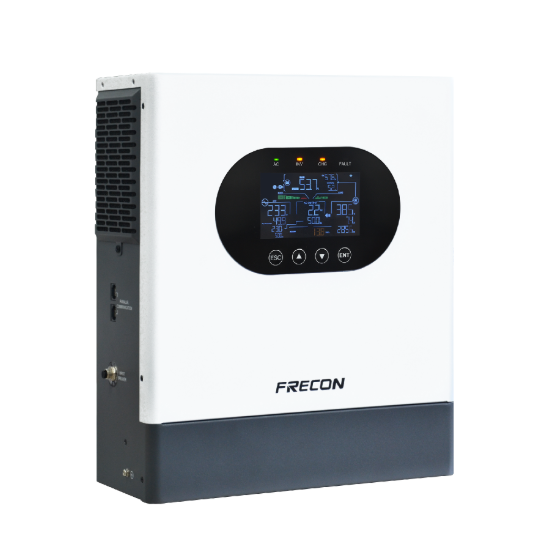
The SP200 Solar Hybrid Inverter from FRECON provides one example. It supports parallel operation from 1 to 9 units, while three or more units in parallel can form a three-phase 380 VAC output. This arrangement gives system designers a possible route from smaller installations toward three-phase operation.
The model has dual output terminals and supports a maximum PV input voltage of up to 500V. It can also support PV feed-in to the grid where local policies allow. These functions still need to be matched with the farm’s battery capacity, PV array, and load requirements.
Parallel capability should not be treated as a reason to increase system size without calculation. Additional inverter capacity is useful only when the rest of the system can support it.
Signs That an Upgrade Is Becoming Necessary
Several conditions can show that the original single-phase arrangement is becoming restrictive. Repeated overload events, difficulty starting motors, limited capacity for simultaneous equipment, or plans to install three-phase machinery are reasons to review the current design.
At this stage, a single phase to 3 phase inverter solution may be practical, but only after the load profile has been mapped. Engineers should identify which devices run continuously, which operate intermittently, and which create large startup demand.
Maintenance should be considered as well. Larger systems need clear circuit separation, accessible protection devices, and accurate wiring documentation. These details make fault finding easier and reduce confusion when the farm expands again.
Technical support from an off-grid solar inverter manufactuer can help project teams understand parallel limits and product configuration. Still, the upgrade decision should come from the farm’s electrical requirements rather than from inverter capacity alone.
The Upgrade Should Follow the Load
Some off-grid farms are moving toward three-phase capability, but the change is usually driven by equipment needs rather than a general trend. Farms that remain focused on light single-phase loads may have little reason to redesign their system.
A properly planned off grid solar inverter system should connect PV generation, battery storage, inverter capacity, and load behavior in one coordinated design. Products such as the SP200 from FRECON can provide a route to parallel expansion, but their value depends on how the system is designed around real farm demand.
The practical question is whether the farm’s current or future equipment requires three-phase power. If it does, upgrading can support the next stage of operation. If it does not, retaining a simpler single-phase structure may remain the more practical choice.


